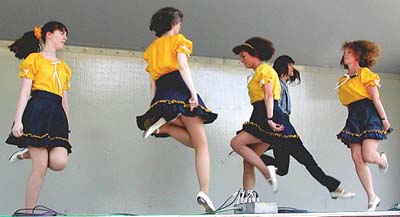
Clogging is a
pastime that carries the mind and feet back in time to the days of our ancestors.
Fire-on-the-Mountain Cloggers®
perform to bluegrass music. Both clogging and bluegrass are art forms that developed
from traditional folk music and dance in the Appalachian Mountains.
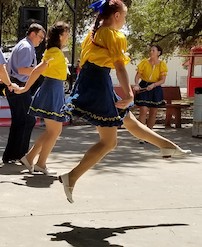 There are many versions of the history of clog dancing
in the United States. Clogging is generally thought to be a combination of the
various dances that settlers to the Appalachian region brought with
them. As the different cultural groups mingled and combined so did their
dances, until what we now know as clogging was formed.
There are many versions of the history of clog dancing
in the United States. Clogging is generally thought to be a combination of the
various dances that settlers to the Appalachian region brought with
them. As the different cultural groups mingled and combined so did their
dances, until what we now know as clogging was formed.
Elements of these various dances could be seen
as people living in the Appalachian mountains taught
one another what steps they knew. The different dances gradually blended
together to create a new dance form—clogging. © All images and text used by permission.
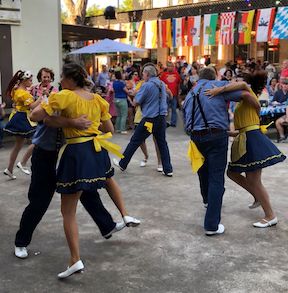 During performances the Fire on the Mountain Cloggers® demonstrate some of the steps such as the Lancaster Clog
Dance from England (which at least gave the dance its name) as well as the polka step,
from Czech and German origins, which is the basic rhythm for clogging. The most
influential of the European cultures is that of the Irish, with the Hard Shoe
dances that bear a striking resemblance to clogging.
During performances the Fire on the Mountain Cloggers® demonstrate some of the steps such as the Lancaster Clog
Dance from England (which at least gave the dance its name) as well as the polka step,
from Czech and German origins, which is the basic rhythm for clogging. The most
influential of the European cultures is that of the Irish, with the Hard Shoe
dances that bear a striking resemblance to clogging.